

Need For Meat is a part of Amazon Associates. As an Amazon Associate, we earn from qualifying purchases. Read our Affiliate Disclosure to learn more.
If you’ve ever tried shaping burgers from store-bought ground beef, you know the problem — mushy texture, mystery fat, and flavor that just doesn’t pop. Grinding meat at home fixes that. You control the cut, the fat ratio, and the grind size. The result? Juicier burgers, cleaner sausage mixes, and better texture every time.
The challenge is finding a grinder that can actually handle real meat — sinew, fat, and all — without clogging or overheating. I’ve tested everything from small attachments to heavy-duty #12 grinders to see which models grind cleanly, stay cool, and are worth the counter space.
This guide covers the best meat grinders for home use, from budget models to serious setups for hunters and batch cooks. Every grinder here was tested on real cuts — chuck, pork butt, chicken thighs — to see how they handled texture, speed, and cleanup. No gimmicks, no fluff, just the tools that actually deliver a proper grind.


How We Chose
I didn’t just look at wattage or price tags — I ran real meat through each grinder. Every model on this list was tested with multiple cuts: beef chuck for burgers, pork shoulder for sausage, and sometimes tougher trimmings or partially frozen brisket to see how the auger handled resistance. I paid close attention to how cleanly each grinder cut the meat versus smearing the fat, because that’s what makes the difference between juicy and dry results.
Performance mattered most, but I also factored in:
- Power and plate size: A strong motor and #12 or larger head usually mean faster, cleaner grinding.
- Ease of cleanup: Some grinders have parts that trap fat or require a toothbrush to reach corners — those lost points fast.
- Durability: I looked for all-metal gears, solid construction, and motors that stay cool during long sessions.
- Attachments and value: Sausage tubes, reverse functions, or storage drawers don’t make or break a grinder, but they add real convenience if they work properly.
Finally, I cross-checked my results with lab tests from trusted sources like Food & Wine, Serious Eats, and Smoked BBQ Source to confirm consistency. Only grinders that performed well under real meat conditions — not just marketing claims — made the cut.
1. STX International Turboforce Classic 3000 Series
I’ve run a lot of meat through this one, and the Turboforce Classic is a beast for home use. The motor peaks at 3,000 W (around 800–1,200 W while grinding), and it chews through big chunks of chuck and pork shoulder without hesitation. The #12 head and 3-pound hopper make batch grinding easy — I’ve done 10 lb of brisket in under 10 minutes without overheating.
The grind texture is clean and well-defined — coarse plates give me that loose burger structure, and the fine plate smooths out sausage meat beautifully. The high/low/reverse buttons are handy when a bit of sinew sneaks in. I also like that it comes with extras like a kibbeh kit, meat claws, and a burger press — though the plunger feels awkward in hand.
Cleanup is the only downside. Most parts are hand-wash only, and the aluminum head needs drying right away to prevent dulling. Still, for around $180–200, the power and throughput make it feel close to a small commercial unit.
| Pros | Cons |
|---|---|
| Extremely powerful; handles sinew and fat easily | Most parts require hand washing |
| Large #12 hopper reduces refilling | Bulky and takes counter space |
| Includes multiple plates, sausage tubes, kibbeh, and burger press | Awkward plunger grip |
2. KitchenAid Metal Food Grinder Attachment (KSMMGA)
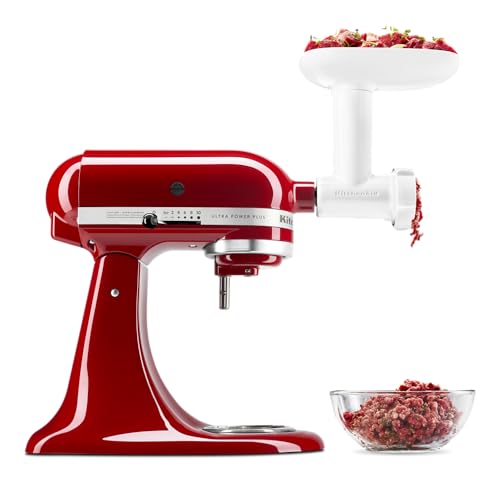
If you already own a KitchenAid stand mixer, this metal attachment turns it into a small, efficient meat grinder. I tested it with about 4 lb of chuck roast — it worked well, though you have to feed slowly because the tube is narrow. The grind quality surprised me: nice, clean strands with little fat smearing, as long as I kept the parts cold.
The metal build feels solid, and the included plates (fine, medium, coarse) cover most needs. It’s not meant for high-volume grinding — I wouldn’t go over 5–6 lb in a session — but for small batches or sausage prep, it’s perfect. I liked how neatly everything fits in the included storage case.
Sausage stuffing is where it struggles; the high placement off the counter makes it awkward to control the casing. Still, for $110–120, it’s the most compact way to start grinding meat at home.
| Pros | Cons |
|---|---|
| Compact and uses your KitchenAid motor | Slow throughput due to narrow tube |
| All-metal build; dishwasher-safe plates | Awkward sausage stuffing angle |
| Good grind texture for small batches | Only works with KitchenAid mixers |
3. Cuisinart Electric Meat Grinder (MG100)

The Cuisinart MG100 is compact, stainless, and surprisingly consistent for its small 300 W motor. I ran 2 lb of beef and pork through it — medium plate first, fine second — and got loose, well-cut strands that held fat pockets nicely. Occasionally the chute clogged with fatty bits, but a quick reverse cleared it.
It’s simple: on/off/reverse and two plates (medium and coarse). That’s it. The pusher stores accessories, though it’s awkward to grip. For small burger batches or sausage test runs, it’s reliable and steady. I pushed 10+ lb through it in one session, and it never overheated.
Cleanup is painless — blades and plates go in the dishwasher, and the rest wipes clean. It’s not fast or powerful enough for big jobs, but for $120–130, it’s a trustworthy everyday grinder.
| Pros | Cons |
|---|---|
| Affordable and easy to use | Small hopper fills quickly |
| Dishwasher-safe plates and blades | Can smear fat with fine grind |
| Compact and steady operation | Awkward plunger design |
4. Sunmile SMG50 Electric Meat Grinder

This one punches above its price. The Sunmile SMG50 has a 250 W rated motor (1,000 W max) with metal gears, and it powers through chuck or pork butt like a champ. I tested 2.5 lb of fatty chuck, and it came out clean and even — no smearing, no slowdown. The 2-inch feed tube means less pre-cutting, which saves a lot of prep time.
Throughput is fast for the price range, especially with coarse or medium plates. It’s not the quietest grinder, and the white plastic body looks cheap, but the internal gearbox is sturdy. I also appreciate the built-in circuit breaker — it keeps the motor safe during long sessions.
If you grind often and want high capacity without spending over $150, this is the one to beat. Just expect to hand-wash most parts.
| Pros | Cons |
|---|---|
| Powerful motor and metal gears | Plastic housing scratches easily |
| Wide feed tube reduces prep time | No cleaning tools included |
| High throughput for the price | Hand-wash only parts |
5. Weston #8 Electric Meat Grinder (330801W)

The Weston #8 feels like a proper workhorse — not flashy, but rock solid. Its 7/8 HP motor (about 650 W) grinds roughly 2–3 lb per minute, and it never choked on the 6 lb batch of beef chuck I tested. The grind texture is clean and uniform, great for burgers or chili meat.
It’s loud — like, power-tool loud — but stable and dependable. The built-in storage for plates and cord is a great touch, keeping things tidy. I love that the reverse switch clears jams instantly. The aluminum body feels durable, though none of it is dishwasher-safe, so plan for a hand wash after every session.
For $160–180, this grinder nails the basics: power, stability, and longevity. It’s ideal if you grind a few times a month and want something that just works.
| Pros | Cons |
|---|---|
| Strong motor; grinds 2–3 lb per minute | Very loud during use |
| Built-in storage for plates and cord | Single speed only |
| Solid construction and stable operation | Hand-wash only; heavy |
6. Weston #12 Electric Meat Grinder & Sausage Stuffer
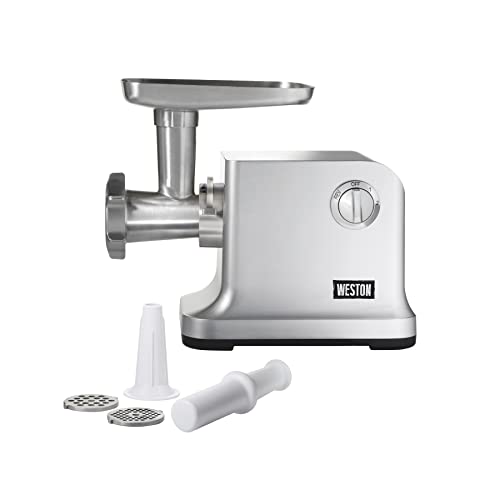
The Weston #12 feels like a serious upgrade from the smaller #8. Its 750 W two-speed motor stays surprisingly quiet while still tearing through 2 lb of chuck in under three minutes. I noticed the grind texture stayed consistent even when switching between coarse and fine plates — no fat smearing, no clogging.
The plunger is the best I’ve used in this price range. It’s shaped to stop vacuum buildup in the feed tube, which keeps the meat flowing smoothly — a small detail, but it matters when you’re doing big batches. The stainless body feels rock solid, though the small tray means you’ll be refilling often.
At around $230–250, it’s heavier than it looks (around 40 lb) but feels like a long-term investment. Great for home cooks who grind weekly or make their own sausage regularly.
| Pros | Cons |
|---|---|
| Fast and quiet for its power level | Small tray limits batch size |
| Comfortable plunger prevents suction jams | Only two grind plates included |
| Solid metal build; easy assembly and reverse switch | Heavy and takes storage space |
7. LEM Big Bite #12 Electric Meat Grinder
When I tested the LEM Big Bite, it felt like stepping into pro-level territory. This 0.75 HP grinder chewed through 2 lb of beef chuck in under a minute — and didn’t even flinch when I fed it chicken bones. The “Big Bite” auger design really works: it grabs and pulls meat down fast without needing to push constantly.
The grind texture is beautifully clean — perfect coarse burgers or sausage-ready fine meat with visible fat specks. It’s loud and heavy (about 40 lb), but the stainless steel construction and metal gears are built for life. The built-in drawer keeps plates and tubes organized, which is a lifesaver if you grind often.
Yes, it’s expensive at $450–580, but this is the one I’d choose for serious meat prep or game processing. It’s overkill for casual users but worth every dollar if you grind often.
| Pros | Cons |
|---|---|
| Massive throughput; grinds 11 lb/min | Bulky and heavy |
| Can handle bones and sinew easily | Loud during operation |
| Durable all-stainless construction with built-in storage | Expensive compared to midrange models |
8. MEAT! Your Maker 0.5HP Dual Grind Meat Grinder
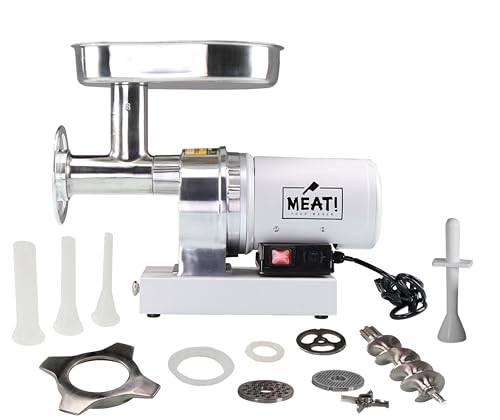
This one’s all about speed and convenience. The MEAT! Your Maker Dual Grind model uses a 0.5 HP motor and a clever dual-plate system that does coarse and fine grinding in one pass. That saves a ton of time — I ran 5 lb of brisket through it, and the results were perfectly uniform in under 2 minutes.
It’s quieter than most high-power grinders and barely warms up during long sessions. The build is excellent: heavy stainless body, smooth auger action, and a handy drawer for accessories. Everything that touches meat is dishwasher-safe, which makes cleanup painless — a rare win for grinders this size.
At roughly $440, it’s pricey, but the time savings and double-pass grind make it worth it for high-volume users or hunters. For anyone grinding under 10 lb a month, though, it’s probably more machine than you need.
| Pros | Cons |
|---|---|
| Dual-grind system saves time and effort | Expensive for casual users |
| Quiet and efficient 0.5 HP motor | Large and heavy |
| Dishwasher-safe attachments and built-in storage | Takes up significant counter space |
9. ALTRA Stainless Steel Electric Meat Grinder (MG090)

The ALTRA MG090 is one of the better budget grinders I’ve used — around $80–90, and it still manages to produce solid results with lean cuts. It’s lightweight, easy to assemble, and the reverse switch helps clear jams when grinding sinewy meat.
I ran 4 lb of brisket through it with the coarse plate, and it took about 9 minutes. That’s slow, but the texture was surprisingly clean once I trimmed off the tough bits. The biggest drawback is the flimsy tray and pusher — you have to go slow or risk bending them. On the plus side, all the meat-contact parts are stainless or aluminum and can go in the dishwasher.
It’s perfect for occasional users who grind small batches of beef, pork, or kibbeh. Just don’t expect commercial speed.
| Pros | Cons |
|---|---|
| Very affordable and easy to clean | Slow and bogs down with sinew |
| Dishwasher-safe plates and blades | Weak plastic tray and pusher |
| Includes sausage and kibbeh attachments | Limited throughput |
10. LEM Products #10 Stainless Steel Clamp-On Hand Grinder
Sometimes the simplest tool still has a place in the kitchen. The LEM #10 is a manual, all-stainless grinder that clamps to your counter. I use it for small test batches — just a few burgers or some fresh sausage mix. The hand crank turns smoothly, and you get a consistent grind as long as you keep the meat cold and pre-cut into small cubes.
Obviously, it’s slow — about a pound or two before your arm starts feeling it — but the grind quality is excellent. Everything is stainless, so it won’t rust, and cleaning is as easy as rinsing and drying. The clamp works well, though it’s too shallow for very thick countertops.
For around $80–100, it’s a great no-electricity backup or a solid starter tool for anyone who wants to learn proper meat texture by feel.
| Pros | Cons |
|---|---|
| Durable all-stainless construction | Manual effort limits throughput |
| Smooth crank and consistent grind | Clamp depth limits surface compatibility |
| Easy to clean and maintain | Not ideal for large batches |
FAQ: Choosing the Best Meat Grinder for Home Use
-
What size grinder do I need for home use?
For most home cooks, a #8 or #12 grinder is ideal. A #8 is compact and fast enough for small batches (under 10 lb at a time). If you process large amounts of meat — say, bulk burger prep or venison season — go for a #12. The wider feed tube and stronger motor keep things moving without clogging.
-
How much power is enough for clean grinding?
Look for at least 300 watts for small batches and 700+ watts for heavy use. The difference shows in how the grinder handles fat and sinew. Underpowered units smear the meat and heat up fast; stronger motors slice cleanly and stay cool, keeping that ideal coarse texture.
-
What grind plate should I use for burgers, sausage, or chili?
Coarse plate (8 mm): best for chili and rustic burgers — looser texture and more juice.
Medium plate (4.5–6 mm): great all-around option for most ground beef and pork.
Fine plate (3 mm): ideal for smooth sausage or pâté-style mixes.
I usually do a double grind — coarse first, fine second — for sausage to keep the fat well distributed. -
How do I clean a grinder after working with fatty meat?
Always run a few pieces of stale bread through the grinder first — it pushes out leftover fat. Then disassemble, wash parts in hot soapy water, and dry them immediately. Avoid soaking aluminum parts for long; they’ll discolor. Stainless steel parts can be air-dried safely.
-
Can home grinders handle bones?
Most can’t. Only heavy-duty models like the LEM Big Bite #12 or STX Turboforce Classic can handle soft bones (chicken or rabbit). For beef or pork bones, use a bone saw or dedicated pet-food grinder — standard home units will burn out.
-
Should I chill meat before grinding?
Absolutely. Cold meat grinds cleaner and faster. I keep my cubed meat and grinder parts in the freezer for about 20 minutes before starting. This keeps fat firm, prevents smearing, and gives you a nice, defined grind that cooks up juicier.
Conclusion
Once you’ve ground your own meat, there’s no going back. You taste the difference — the cleaner texture, the balanced fat, and that deep, fresh flavor you just can’t get from store-bought packs.
The grinders I tested here all do one thing right: they treat meat with respect. From the budget-friendly ALTRA to the powerhouse LEM Big Bite, each delivers clean cuts without smearing fat or overheating. Whether you grind five pounds for a weekend cookout or fifty during hunting season, the right grinder saves time, improves texture, and makes your burgers and sausages taste like they came from a pro butcher shop.
If you care about how your meat feels, tastes, and cooks — invest in a grinder that keeps it clean, cold, and consistent. Once you do, you’ll never settle for pre-ground again.


